Modeling a Hype Drop as a Distributed Systems Problem
Introduction
A limited drop is a timed sale where stock is much smaller than demand. Sneakers, concert tickets, Pokémon card restocks, GPU launches: different products, same pressure. A lot of clients hit the site at roughly the same time and try to reserve something before it is gone.
If you only think about “click faster,” you miss most of the system. Many clients try to update the same stock keys at once. Checkout takes several steps, each with its own timeouts. Errors are not all the same. The site may run a free-for-all claim, a waiting room, or a lottery.
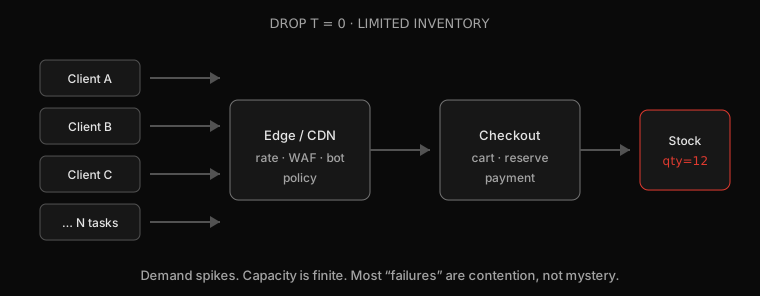
const drop = {
  resource: { itemId: "SKU|event|set", variant: "size|seat|edition", qty: 12 },
  demand: { clients: 50_000, peakRps: 2e4 },
  controlPlane: "free_for_all | queue | lottery",
  path: ["monitor", "session", "claim", "details", "pay", "confirm"],
  constraints: ["hold_ttl", "idempotency", "rate_limits", "bot_policy", "fraud"],
};
System model
| Part | What it does | How it fails |
|---|---|---|
| Stock key | count per size, seat, or SKU | out of stock, oversell, stale read |
| Hold / cart | short lock until payment finishes | expires, abandoned, paid twice |
| Session | login cookies, device binding | expires, rotates, breaks on IP change |
| Edge policy | bot checks, rate limits, challenges | soft challenge, hard 403 |
| Payment | charge, 3DS, fraud checks | decline, timeout, risk block |
| Clock | drop open time, hold TTL, pay window | correct work still loses if late |
You are not fighting for “the shoe” or “the ticket.” You are fighting for a short hold on a key, and every hop can still reject you.
Reservation semantics
A bad inventory model is a plain read, then write. Under load that races:
Unsafe under load// demo only. races when many clients claim at once.
let stock = 12;
function tryReserve() {
if (stock <= 0) return "OOS";
stock -= 1;
return "RESERVED";
}
Real systems usually do something safer:
- Safe decrement: only lower stock if it is still > 0 (compare and set, Redis script, or SQL
UPDATE … WHERE qty > 0) - Hold row: a record with
hold_id, owner, andexpires_at - Commit or release: payment turns the hold into sold, or the timer frees it
// shape only
const hold = {
  holdId: "h_9f2c",
  key: { itemId: "SKU-1", variant: "10" },
  owner: "session_ab12",
  expiresAt: Date.now() + 10 * 60_000, // 10 minute hold
  state: "HELD", // HELD | COMMITTED | EXPIRED | RELEASED
};
// add to cart is not the order. commit happens later.
A few consequences:
- Claim rate and sell rate are different numbers.
- If holds last 10 minutes and payment is slow, you can have more holds than real stock left.
- Expired holds must free stock without restarting a full rush on the API.
- If a client treats “added to cart” as done, hold expiry and card declines get misread as “bot detection.”
Example: a ticket site gives you a 10 minute seat hold; a shoe site gives you a cart that dies after 15 minutes. Same idea.
Admission control
Not every drop puts the fight on stock. Sometimes the fight is getting in the door.
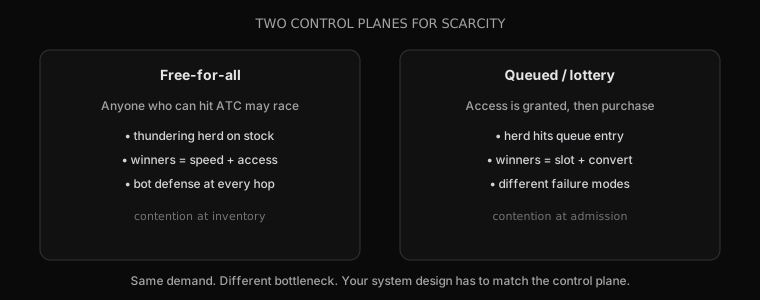
| Mode | Where it bottlenecks | Mid win | Final win |
|---|---|---|---|
| Free for all | claim / hold on stock | hold acquired | paid order |
| Queue | join queue + stay alive | pass issued | pay before the pass dies |
| Lottery | draw selection | selected | finish checkout |
Free for all (common on retail restocks) puts bot checks on every heavy step. Ticket queues move pressure earlier: join, heartbeat, convert the pass. Lotteries move most of the fight off checkout. Track the mid win that matches the mode, or your success rate is noise.
Pipeline as a state machine
Think of purchase as a path with named steps and allowed moves, not one big “buy” call. The labels change by site (add to cart, pick seats, reserve pack). The path stays similar.
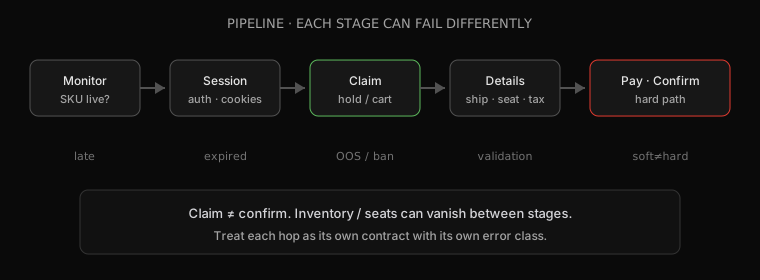
const stages = [
  { name: "monitor", ok: "item_live",  fail: ["not_live", "parse_miss"] },
  { name: "session", ok: "authed",     fail: ["login_required", "expired"] },
  { name: "claim",   ok: "held",       fail: ["oos", "soft_block", "hard_block"] },
  { name: "details", ok: "info_set",   fail: ["validation", "geo_block"] },
  { name: "payment", ok: "authorized", fail: ["risk", "3ds", "decline", "timeout"] },
  { name: "confirm", ok: "order_id",   fail: ["hold_expired", "final_oos", "duplicate"] },
];
- Claim is not checkout. Passing early steps and dying on pay is normal. Related: soft vs hard paths.
- Error types matter. Out of stock, rate limit (429), and hard block need different next moves.
- State sticks. Cookies, hold IDs, checkout IDs, and queue tokens are costly to create over and over.
Metrics that matter
One “hit rate” mixes stock, policy, and payment into a single number. A funnel with timing per step is more useful:
Funnel + timersconst run = {
n: 1000,
live: 980,
sessionOk: 910,
claimOk: 140,
detailsOk: 120,
payOk: 38,
confirmed: 31,
p95ms: { claim: 180, payment: 2400, confirm: 320 },
};
// confirmed/n alone is weak. watch claim→pay and pay→confirm.
Count failures by stage and error type. If you cannot tell out of stock from a ban from a payment timeout, you cannot fix retries or capacity.
Failure classes
| Class | What you see | What to do |
|---|---|---|
| Out of stock | claim or confirm empty | stop or switch size/seat; do not spam |
| No entry | queue miss / draw loss | different path; not a claim retry |
| Soft policy | challenge, delay, extra step | handle the challenge; do not raise claim rate |
| Hard policy | 403 on the action | stop that identity; check IP/session match |
| State expired | hold / pass / session dead | rebuild state once on purpose |
| Payment / fraud | decline, 3DS, risk kill | retry only with an idempotency key |
| Client bug | bad parse / illegal step | fix the parser or state machine |
Retrying the wrong class is how clients make load worse.
Retries under load
Retrying everything is easy and usually wrong: blind retries add traffic to a system that is already hot. Policy should depend on the error type, with hard caps. Use backoff with jitter only for rate limits and brief server errors.
Per class policyfunction shouldRetry(err, ctx) {
switch (err.class) {
case "oos":
case "hard_block":
case "soft_challenge":
case "state_expired":
return false;
case "rate_limit":
return ctx.attempts < 3; // caller adds jittered backoff
case "transient_5xx":
return ctx.attempts < 2;
default:
return false;
}
}
- Idempotency keys on pay and confirm. A timeout plus a second submit can create a double charge or double order.
- Circuit breakers per profile and per site when hard blocks spike. Keeping full send after a ban turns a bad minute into burned accounts or IPs.
Latency budget
Speed only helps if it spends time where the clock is tight. Hold TTL turns total time into a deadline. Optimize the step that eats most of the budget, not the step that is easiest to tweak.
| Step | What you pay for | Where to improve |
|---|---|---|
| Monitor → live | how fast you see the drop | poll vs push, parse cost |
| Session warm | login / cookies when cold | warm sessions before T=0 |
| Claim RTT | getting the hold | reuse connections, smart retries |
| Details | extra form steps | send fewer round trips if the API allows |
| Payment | bank + risk + 3DS | often the slow p95 |
| Confirm | final commit | safe commit, hold race handling |
If claim p95 is 150ms and payment p95 is 2.5s, cleaning request headers will not move orders. That gap is also why client design has to plan for warm state and stage limits, not just raw RPS.
Client architecture
Whether you are building an automated client or the storefront itself, the same pieces keep showing up:
- A clear state machine: steps, legal moves, end states
- Session and identity: cookies, device, sticky proxies (see coherence, client VM antibots)
- An entry mode that matches free for all, queue, or lottery
- Caps on parallel work, per identity rate limits, circuit breakers
- Metrics per step and typed errors
- Scheduling that respects drop open time and hold TTL
const task = {
  profileId: "p_1024",
  resource: { itemId: "SKU|event", variant: "size|seat" },
  proxy: { sticky: true, class: "residential" },
  session: { warm: true },
  mode: "request", // browser only if the path needs it
  policy: {
    maxClaimAttempts: 2,
    backoffMs: [150, 400],
    stopOn: ["hard_block", "oos", "pay_decline"],
  },
  metrics: { stage: null, errClass: null, ms: {} },
};
Takeaways
Limited drops are reservation systems under heavy load, with bots and fraud in the mix and a hard clock. Treat claim as a hold with a timer, failures as named types, and success as a funnel, not one percent. Shoes, tickets, and cards change the labels. The graph stays the same.
Related: stealth browsers · VM antibots · browser automation.