The $40 Billion Problem: Understanding Google Play Integrity’s Cat-and-Mouse Game
Part 1
It “protects over 2 billion devices”—but is it really secure? 🕵️♂️

Every year, mobile app fraud costs the global economy an estimated $40 billion. Banking apps bleed money through API abuse. Games lose millions to cheaters and bot farms. Streaming services watch their premium content get pirated through modified apps.
And at the center of Android’s defense against this chaos? Google Play Integrity API—a security framework that’s simultaneously the most powerful and most attacked component of mobile security today.
But here’s what most developers don’t know: the system they’re trusting with their app’s security is locked in an escalating war with some of the most talented reverse engineers in the Android community. And often times, the attackers end up winning.
What is it?
Play Integrity API is a hardware-backed attestation system that creates cryptographically signed proof about your device’s security state.
It’s the successor to the deprecated SafetyNet Attestation API, but calling it an “upgrade” is a massive understatement. This isn’t just another API; it’s a complete architectural shift in how Android handles security.
In simpler terms, it allows developers to remotely evaluate the integrity of the user’s app and device. But here’s where it gets interesting …
How does it work?
Say a user wants to do a “high-risk” action, for example, wanting to transfer money or checkout an order, the app then requests the evaluation test from Play Integrity, the test gets ran and then get send to Google play’s servers. Google Play then sends the results to your backend and you decide what to do from there.
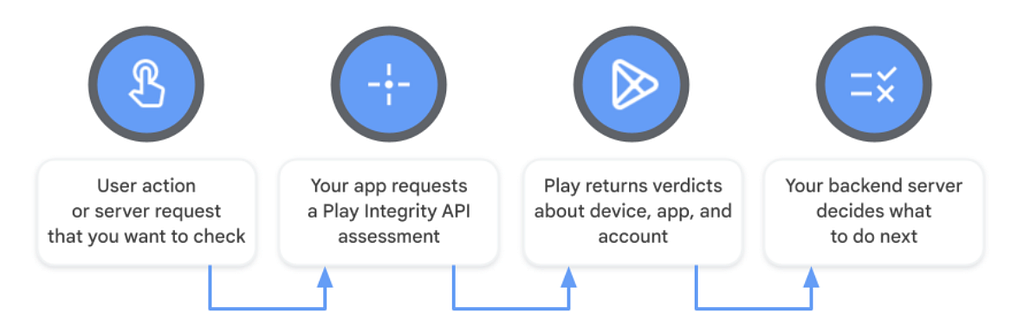
Here’s the high-level flow:
- Request from the app — A user presses the **Transfer Funds** button in your Bank app. The app calls the Play Integrity API first, sending along a nonce (a unique, random value from your backend) so the verdict can’t be reused later.
- Collection & attestation — Google Play Services gathers details about the app (package name, signature, version), the device (certification, OS, bootloader status, security patch level), and the account’s licensing state. On devices that support it, the secure hardware (Trusted Execution Environment) cryptographically signs these details.
- Google server evaluation — This data is sent to Google’s servers, which run it through their detection logic to determine the device and app’s trust level.
- Signed verdict creation — Google returns a cryptographically signed token (JSON Web Signature) containing the results.
- Backend validation — Your backend receives the token from the app, verifies Google’s signature, checks that the nonce matches, and decides what actions to allow or block.
Because the attestation happens outside your app’s process and is signed by Google, it’s far harder for an attacker to forge a passing result — and proper server-side validation ensures that even if the app is modified, the backend will still catch an invalid token.
Google play has three different evaluation results:
- MEETS_BASIC_INTEGRITY — Device passes basic checks (not obviously rooted/emulated)
- MEETS_DEVICE_INTEGRITY — Play Protect certified, locked bootloader, verified OS
- MEETS_STRONG_INTEGRITY — Same as above + recent security patches + hardware-backed proof
What makes it so popular and hard to figure out?
The Play Integrity API has two traits that make it both a go-to tool for developers and a persistent challenge for reverse engineers: massive reach and deep complexity.
For developers, its appeal starts with coverage — a single integration works across more than two billion Android devices, instantly giving them a unified, Google-managed security layer without having to maintain their own root detection or device trust system. (Why make your own when you can trust Google?)
It also delivers far more than a simple “pass/fail” signal; Play Integrity combines app authenticity checks, device certification status, licensing validation, and even activity monitoring into one verdict. On newer devices, those verdicts are signed by keys stored in the Trusted Execution Environment, adding a layer of cryptographic trust that’s difficult to forge.
From an attacker’s perspective, the challenge comes from how little of the process is visible. The sensitive logic runs inside Google Play Services and on Google’s servers, not in the app itself, so simply reverse engineering the APK doesn’t reveal the full picture.
The system also evolves constantly, with Google pushing silent updates that change detection methods, verdict formats, and back-end rules — meaning a bypass that works today might fail tomorrow.
Hardware binding makes spoofing strong integrity nearly impossible without a real device’s keys, and the signed verdicts are verified server-side in most well-built apps, making client-only tampering ineffective.
This combination of global reach, layered checks, and cryptographic enforcement is why developers trust it — and why reverse engineers have to continuously adapt just to keep pace.
Why Should You Care? (The Real Stakes)
If you own a app, you’re not just worried about attackers gaining unauthorized access to your API; you’re worried about:
- Automated fraud rings using rooted devices to bypass your rate limiting
- Modified apps that skip security checks and directly hit your backend
- Emulator farms running thousands of instances to abuse promotional offers
- Overlay attacks stealing credentials while appearing legitimate during the whole process
Without Play Integrity, you’re essentially running blind. With it, you get a powerful ally — but one that comes with its own complex ecosystem of bypasses, workarounds, and ethical debates.
Real world examples of Usage
Let’s give some examples of popular apps using this framework:
Google Wallet / Google Pay: Checks to enable tap-to-pay and will block entirely on uncertified or rooted devices.
Pokémon GO: Enforces integrity checks to detect rooted devices and block location spoofing.
Netflix: Uses device integrity checks (in combination with Widevine DRM) to hide itself from uncertified devices and block HD streams on compromised environments.
Banking apps like Revolut, Santander, and Barclays: Often combine Play Integrity with other checks to block rooted or uncertified devices from logging in or making transfers.
Here is a real simplified example of a typical bank app’s transferMoneyfunction (in python for simplicity) :
def should_allow_transaction(integrity_token, amount):
    """
    This is what Play Integrity validation looks like in practice
    """
    # 1. Ask Google: "Is this device trustworthy?"
    verdict = google_play_integrity.validate(integrity_token)

    # 2. Google responds with trust levels
    device_trust = verdict['deviceIntegrity']['deviceRecognitionVerdict']

    # 3. Make decision based on trust level
    if 'MEETS_STRONG_INTEGRITY' in device_trust:
        return "ALLOW"  # Fully trusted device

    elif 'MEETS_DEVICE_INTEGRITY' in device_trust:
        return "ALLOW_WITH_2FA"  # Certified but maybe outdated

    elif 'MEETS_BASIC_INTEGRITY' in device_trust:
        return "READ_ONLY"  # Possibly rooted/modified

    else:
        return "BLOCK"  # No trust - probably emulator or compromised
Step 1: Get the integrity check performed on the device and send it to Google.
Step 2: Google then sends their evaluation of the device back to your backend.
Step 3: Now depending on how strict you want be, you can decide from letting any device to only the most secure devices to perform the action!
But is it really secure?
Everything I just told you about Play Integrity being powerful and secure? It’s true.
Everything the Android modding community says about bypassing it? That’s also true.
How can both be right?
Because there’s a secret war happening in your pocket right now. On one side: Google’s engineers with unlimited resources and hardware-level security. On the other: a distributed network of hackers who treat “unbreakable” as a personal challenge.
And here’s the part that should terrify every app developer
This isn’t just hobbyists tinkering anymore. There’s real money flowing through this ecosystem:
- 💰 Stolen key boxes: $50–500 per device certificate
- 💰 Token-as-a-Service: $1-$3 per “valid” token
- 💰 Bypass tools: “Donations” worth thousands monthly
- 💰 Underground markets: Telegram groups with 100K+ members
Someone is making millions helping apps get bypassed. Is it your app?
In Part 2
I’ll show you exactly how these bypasses work:
- How Magisk modifies the boot process to hide root.
- How Shamiko intercepts API calls before they reach Google.
- How Play Integrity Fix makes a $50 device look like a $900 Pixel 8 Pro.
- How Tricky Store uses leaked hardware keys from factory workers.
More interesting though?
The money. There are Telegram groups with 100,000+ members trading keyboxes. Services charge $1–$3 per bypassed token. Developers in Eastern Europe make $10k/month maintaining bypass tools. And in Chinese factories, employees can make more selling one keybox file than their monthly salary.
Google knows. They can’t stop it. And your app is probably already affected.
Just a heads up: Part 2 will be a bit more technical. 🤓
Part 2
Behind the billion-dollar bypass economy

Remember that “hardware-backed attestation” from Part 1? The one that’s supposedly unforgeable? Let me tell you about a Telegram channel with 87,000 members where you can buy a working bypass for $50. Or the GitHub repository with 45,000 stars that makes rooted phones invisible to Google. Or the factory worker in Shenzhen who made $30,000 last year selling a single XML file. Welcome to the dark side of Play Integrity.
Why Root Breaks Everything
Before we dive into bypasses, let’s understand why rooting fundamentally breaks Play Integrity. It’s not just about having superuser access — it’s about the chain of trust being severed at multiple critical points.
Android’s security starts at the hardware level with a process called Verified Boot:
Hardware Root of Trust (burned into chip)
    ↓ verifies
Bootloader (checks signature)
    ↓ verifies
Kernel (checks dm-verity hashes)
    ↓ verifies
System Partition (checks SELinux policies)
    ↓
Android OS starts
Unlocking the bootloader flips the device’s Verified Boot state to orange (unlocked). That state propagates up the attestation chain.
When hardware-backed attestation is used, you can’t plausibly claim a locked/verified state to Google’s servers even if you hook local property reads. This is the core reason rooted/unlocked devices typically fail Device/Strong integrity.
What DroidGuard Actually Checks
Reverse-engineering talks show DroidGuard evaluates a wide range of signals:
- Boot state, SELinux mode, and
sutraces - Build properties, mounts, and root-app packages
- System hash integrity and keystore attestation
It also uses anti-hooking and obfuscation techniques to resist tampering.
# Simplified version of what DroidGuard looks for
def check_device_integrity():
    checks = {
        'bootloader_state': read_property('ro.boot.verifiedbootstate'),
        'selinux_enforcing': is_selinux_enforcing(),
        'su_binary_present': check_paths(['/system/bin/su', '/system/xbin/su']),
        'magisk_present': detect_magisk_files(),
        'system_props': validate_build_properties(),
        'mount_points': check_suspicious_mounts(),
        'running_processes': find_root_processes(),
        'installed_packages': detect_root_apps(),
        'file_integrity': verify_system_hashes(),
        'hardware_attestation': get_keystore_attestation()
    }
    return calculate_verdict(checks)
But here’s the thing: if you control the environment these checks run in, you can control their results.
The Bypass Arsenal: Tools of the Trade
Magisk: The Foundation of Modern Root
Magisk isn’t just a root tool — it’s a complete reimplementation of how Android boots. Created by topjohnwu, it achieves “systemless” root through surgical precision:
# How Magisk modifies the boot process
1. Patch boot.img with custom init
2. Custom init runs before real init
3. Set up tmpfs overlay for /system modifications
4. Bind mount modified files over originals
5. Hide all traces before app launches
The genius is in the implementation. Magisk never actually modifies /system - it creates a parallel filesystem layer.
Play Integrity Fix: The Fingerprint Spoofer
This is where things get clever. Play Integrity Fix doesn’t try to hide modifications — it makes your device look like a completely different one:
// pif.json - The magic configuration file
{
 "FINGERPRINT": "google/cheetah/cheetah:14/UP1A.231105.001/10817346:user/release-keys",
 "MANUFACTURER": "Google",
 "MODEL": "Pixel 7 Pro",
 "BRAND": "google",
 "PRODUCT": "cheetah",
 "DEVICE": "cheetah",
 "SECURITY_PATCH": "2023–11–05",
 "FIRST_API_LEVEL": "33",
 "BUILD_ID": "UP1A.231105.001",
 "INCREMENTAL": "10817346"
}
Tricky Store: The Nuclear Option
This is where we enter legally questionable territory. Tricky Store doesn’t hide or spoof — it steals:
<!-- keybox.xml - Worth more than gold -->
<Keybox>
    <DeviceID>XXXXXXXXXXXXXXXX</DeviceID>
    <Key algorithm="ecdsa">
        <PrivateKey format="pem">
            -----BEGIN EC PRIVATE KEY-----
            MHcCAQEEIKp0Y5... [REDACTED]
            -----END EC PRIVATE KEY-----
        </PrivateKey>
    </Key>
    <CertificateChain>
        <Certificate format="pem">
            -----BEGIN CERTIFICATE-----
            MIICnDCCAYSgAwIB... [REDACTED]
            -----END CERTIFICATE-----
        </Certificate>
    </CertificateChain>
</Keybox>
These keyboxes contain legitimate attestation keys extracted from real devices. When injected, they produce valid hardware attestation that passes even MEETS_STRONG_INTEGRITY — because technically, they ARE valid hardware attestations.
Of course, bypassing Play Integrity isn’t just about bragging rights on XDA forums — it’s an economy. And like any lucrative market, it has suppliers, distributors, and end customers all playing their role.
The Black Market: Following the Money
The Keybox Economy
The underground keybox trade is more organized than you’d think:
Tier 1: Factory Leaks ($5,000-$20,000)
- Employees at ODM factories in China/Vietnam
- Access to thousands of device keys
- Sold in bulk to distributors
Tier 2: Distributors ($500-$2,000)
- Buy bulk, sell individual keys
- Maintain “clean” key pools
- Rotate keys before Google revokes them
Tier 3: End Users ($50-$200)
- Individual keybox purchases
- Often bundled with installation service
- “Lifetime” warranties (until revoked)
How do attestation keys (keyboxes) get leaked?
Method 1: The Factory Floor
There’s verified evidence that factory-provisioned attestation keys have leaked into the wild — and that Google is actively revoking compromised keys.
Here’s what’s actually known:
- A documented security incident confirms that “a large number of factory-provisioned attestation keys were leaked to the public” and are now used to bypass integrity checks
- Google’s official documentation explains that these leaks affect older provisioning methods, and that as soon as leaks are detected — whether through public discovery or forensic analysis — the affected certificates are added to a revocation list .
- In forums, users with technical insight note that attestation keyboxes — especially in older devices — can indeed be leaked, often for resale or bypass purposes.
Method 2: OEM Implementation Flaws
“There are some OEMs that, for some reason I don’t know, incorporate the keybox in the device partitions, Nubia put them in the vendor partition, Asus in persist and some others that I don’t want to mention keep them encrypted (but recoverable) in OTA updates of the devices”
This is a completely separate attack vector where manufacturers accidentally store keyboxes in easily accessible partitions instead of secure hardware.
This creates a plausible attack vector: if a rooted or compromised device can access these partitions, the keybox may be exfiltrated, bypassing the protections intended by Verified Boot and the Android Keystore.
How are they distributed?
- Telegram Channels (The Public Market)
Channel: "🔐 Premium Keybox Store 🔐"
Members: 87,000+
Daily posts:
    "🔥 FRESH Pixel 8 Pro Keybox - $400"
    "⚡ BULK DEAL: 100 Samsung S24 - $30,000"
    "✅ Tested working with all banking apps"
Payment: Crypto only
Guarantee: "Working for 30 days or replacement"
- Discord Servers
- Invite-only communities
- Higher quality keyboxes
- Direct dealer relationships - Dark Web Markets (The Professional Tier)
Marketplace: [REDACTED]Market
Vendor: KeyMaster2024
Rating: ⭐⭐⭐⭐⭐ (2,847 sales)
Listing: "Enterprise Keybox Package"
  - 1,000 mixed device keyboxes
  - Automated rotation system
  - API access for integration
  - 24/7 support
Price: 5.2 BTC (~$250,000)
Token-as-a-Service: The API Economy
# Actual service found in the wild (simplified)
class TokenService:
    def __init__(self):
        self.device_pool = []  # 100+ real phones
        self.load_balancer = LoadBalancer()

    def get_integrity_token(self, package_name, nonce):
        # Route to available device
        device = self.load_balancer.get_device()

        # Generate real token on real hardware
        token = device.request_play_integrity(package_name, nonce)

        # Bill customer
        self.bill_customer(customer_id, TOKEN_PRICE)  # $1-3

        return token
These services operate from:
- Russian VPS providers (legal gray area)
- Chinese cloud services (lax enforcement)
- Bulletproof hosting in Eastern Europe
Monthly revenue for successful operations: $50,000-$200,000
The Developer Ecosystem
The bypass tool developers themselves have created a sustainable economy:
Private Commissions:
- Custom bypasses for specific apps: $10,000-$50,000
- Mostly gambling and gaming companies
- Paid in cryptocurrency to be “hard to track”
Patreon/Ko-fi Donations:
- Top developers: $5,000-$15,000/month
- Regular updates keep donations flowing
- “Early access” to new bypasses
Telegram Premium Groups:
- $20–50/month for “VIP” access
- First to get working bypasses
- Direct support from developers
How They Generate Unlimited Tokens
Here’s where it gets genuinely impressive from a technical standpoint. Some groups have reverse-engineered enough of the Play Integrity protocol to generate tokens:
// Frida script used in the wild
Java.perform(function() {
    var IntegrityManager = Java.use("com.google.android.gms.common.api.internal.BaseImplementation");

    IntegrityManager.execute.implementation = function() {
        console.log("Intercepted Integrity request");

        // Check cache for valid token
        var cachedToken = getCachedToken(arguments[0]);
        if (cachedToken && !isExpired(cachedToken)) {
            // Return cached token instead of making new request
            return cachedToken;
        }

        // Let original request proceed
        var result = this.execute.apply(this, arguments);

        // Cache the result
        cacheToken(arguments[0], result);

        return result;
    };
});
You can’t mint genuine tokens offline — they’re signed by Google. What exists is token farming: fleets of real, uncompromised devices request large numbers of tokens for resale. Google introduced recentDeviceActivity to help developers spot and block this pattern.
But why do they want to get around Play Integrity?
The possibilities are endless and almost all are to make money themselves.
- Streaming Service Theft / Streaming piracy
– Reselling Video Streaming subscriptions (buy “In Turkey $3” -> resell as “U.S. $8”
- Pure profit: $5/user/month × 10,000 users = $50,000/month - Ride-Share/Delivery Fraud
- GPS spoofing for surge pricing areas
- Bot accepting only high-value rides
- Average fraud ring income: $200–500/day per device - Banking & Crypto Abuse
- Automated account creation for bonus harvesting
- API limit circumvention for trading bots
- Credential stuffing at scale - Game Currency Farming / Game cheating
- Bot farms running 24/7 on emulators
- Selling in-game currency for real money
- One successful farm: $50,000/month
Conclusion: The Unwinnable War
As I write this, there’s a 17-year-old in Russia who just found a new bypass that will work for the next 3 months. There’s a factory worker in Vietnam photographing keyboxes that will sell for $10,000. There’s a developer in Poland maintaining tools used by millions. And there’s a Google engineer in Mountain View preparing the next countermeasure.
This isn’t a battle between good and evil. It’s a fundamental conflict between security and ownership, between protection and freedom, between corporate control and user autonomy.
The Play Integrity API is both a marvel of engineering and a symbol of everything wrong with modern tech. It protects millions from fraud while treating every power user as a potential criminal. It secures banking apps while killing the custom ROM scene. It prevents cheating while enabling unprecedented corporate surveillance.
The bypasses will continue. The black market will thrive. The cat-and-mouse game will escalate. And somewhere in between, we’ll have to decide what kind of digital future we want:
One where devices obey their manufacturers? Or one where users control what they own?
The code is already written. The choice is ours.
Disclaimer: This article is for educational purposes only. The author does not condone or encourage bypassing security measures, violating terms of service, or engaging in illegal activities. The technical details provided are already publicly available and are presented here to inform developers about the threats their applications face.